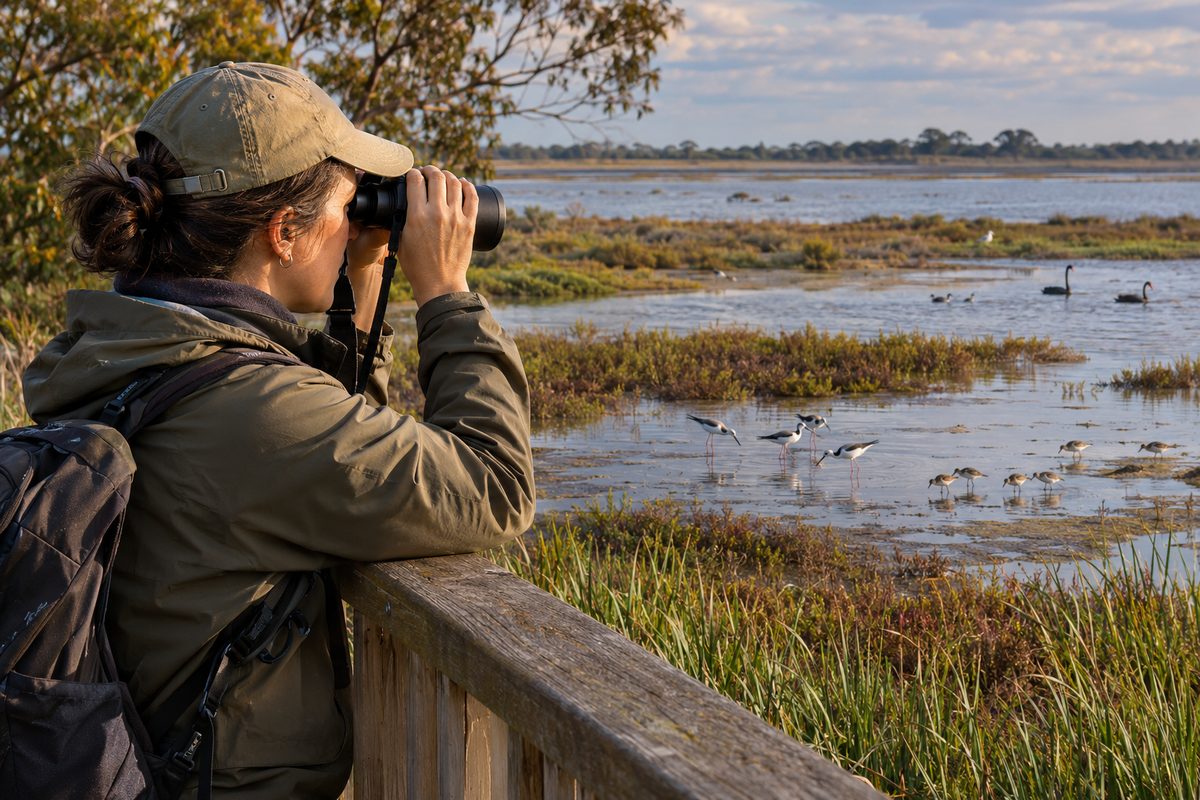
Cheetham Wetlands Birdwatching from Public Viewpoints
You can watch birds at Cheetham Wetlands without entering the protected wetland by using designated public paths, coastal edges and signed viewing areas. This approach gives you broad views across shallow water, saltmarsh and exposed mud while keeping sensitive habitat free from disturbance. Conditions change with water levels, wind and season, so a careful observer can see a different mix of birds on each visit.
Cheetham Wetlands sits beside the western shore of Port Phillip near Point Cook. Its former saltworks ponds form a large feeding and resting area for local waterbirds and seasonal migrants. The site can look quiet at first. Slow scanning often reveals birds feeding along distant margins, resting on islands or moving between ponds.
This guide focuses on watching from lawful public viewpoints. It does not direct visitors into closed management tracks, pond banks or restricted habitat. Check current signs at the site because access may change during maintenance, flooding, fire danger or habitat works.
Where should you look from without entering the wetlands?
Start from marked public routes and stop where the view opens across water or saltmarsh. A useful viewpoint does not need a formal platform. A gap in vegetation beside an authorised path may offer a clear sightline while keeping you outside the habitat.
The best position is often one that lets you scan several habitat edges at once. Look for shallow pond margins, small islands, muddy strips and channels between pools. Birds gather where water meets exposed ground because these edges hold insects, small aquatic animals and plant food.
Stay behind fences and obey every closure sign. A narrow bank may look like a walking track, but many banks are part of the wetland system rather than public access routes. Entering them can push feeding birds into deeper water and force resting flocks to fly. It can also place visitors near soft mud, hidden drains and unstable pond edges.
If a bird moves away, raises its head repeatedly or gives alarm calls as you approach, you are too close. Step back and remain still. Viewing from a greater distance often produces better behaviour to watch because the bird returns to feeding instead of tracking your movements.
For broader local context before leaving home, the Point Cook Tideline provides a starting point for exploring Point Cook and its coastal setting.
How do you find birds across such a wide area?
Do not scan the whole wetland at full speed. Divide the view into small zones and search each one from left to right. Begin with the nearest waterline, then check exposed mud, islands and the far bank. Repeat the scan at a higher level for flying birds.
Movement is easier to detect than colour at long range. Watch for a feeding bird dipping its head, a line of ducks crossing open water or a flock turning in the air. Once movement catches your eye, use binoculars to inspect it.
Large pale areas can cause glare, while heat above exposed ground can blur distant birds. Use a fence post, shrub or pond corner as a reference point. This makes it easier to guide another observer to the same bird. A clear direction such as “just right of the low island” works better than pointing across open water.
A Spotting scope is useful at Cheetham Wetlands because many birds remain far from public paths. A stable tripod matters as much as magnification. High power on a shaking support gives a worse view than lower power on a firm one. Start at low magnification to locate the bird, then increase it only if the air is clear.
Binoculars remain the best first tool. They are quick to raise and give a wide field of view. If you carry both, find each bird with binoculars before shifting to the scope.
When do water levels and tides help?
There is no single perfect hour because different conditions move birds between feeding and resting areas. Tide, pond depth, wind and light all change what can be seen from a public viewpoint.
Along the coastal side, a rising tide may cover feeding ground and move shorebirds towards higher roosts. A falling tide can expose mud where birds search for small prey. Managed wetland ponds do not always rise and fall with the bay in the same way, but the wider tidal cycle still affects bird movement around the coast.
Low sun can make identification hard when you face glare. If possible, choose a viewpoint with the sun behind you or over one shoulder. Cloudy light reduces harsh reflections and may make subtle feather patterns easier to see. Strong wind can drive birds towards sheltered banks, although it also makes a scope harder to use.
Water depth decides which feeding methods work. Dabbling ducks favour water they can reach without diving. Long-legged waders can use deeper margins than small shorebirds. A Black swan may feed in open water where its long neck reaches submerged plants. If one pond seems empty, check a shallower edge rather than assuming no birds are present.
Which birds can public viewpoints reveal?
Expect the mix to change. Cheetham Wetlands supports ducks, swans, grebes, cormorants and several kinds of shorebird, but no species is guaranteed on a given visit. Weather and water management can shift birds beyond easy viewing range.
Use shape and behaviour before colour. A Water bird sitting low on the surface may be a duck or grebe. A bird standing on exposed mud may be a plover, stilt or sandpiper. Note the length of its legs, bill shape, feeding action and whether it stays alone or joins a flock.
A Black swan is easy to recognise by its size, dark body and long curved neck. Smaller birds demand more care. Plumage can change with age and breeding season, while distance can hide colours. Record what you can see rather than forcing an identification. “Small shorebird with a short straight bill” is a useful field note even when the species remains uncertain.
Flocks also give clues. Some ducks rest in loose groups on open water. Small shorebirds may feed in close lines along wet mud. Cormorants can gather on exposed structures or banks between fishing trips. Sudden flight may signal a raptor, a passing person or another source of disturbance.
A phone photo through binoculars rarely gives a sharp image, but it can preserve flock shape or a rough size comparison. A camera with a long lens can help confirm features later. Do not chase a record shot by leaving the public route.
Why do migratory shorebirds matter here?
Bird migration links wetlands around Port Phillip with places thousands of kilometres away. Some shorebirds spend the southern summer feeding in Australia, then travel north to breeding grounds in Asia or the Arctic.
This movement forms part of the East Asian–Australasian Flyway, a broad chain of breeding areas, feeding sites and rest stops used by migratory waterbirds. The term East Asian refers to the northern part of that route, while Australasian covers its southern reach. The shorter label Australasian Flyway is sometimes used in general discussion, but East Asian–Australasian Flyway gives the clearer name for the full international route.
Animal migration demands large stores of energy. A shorebird must feed enough to build reserves before a long flight. Repeated disturbance has a real cost because every escape flight burns energy and cuts feeding time. This is why distance matters even when a visitor never touches a nest or plant.
Bird migration also explains why numbers can change quickly. A pond may hold a flock one week and far fewer birds the next. The birds may have moved to another feeding area, gathered at a different roost or begun the next stage of their journey.
Observers can help by recording the date, location and count through a recognised bird survey or citizen science service. Submit only records you can support. An honest uncertain identification is more useful than a confident error.
How can you identify a distant bird with confidence?
Build the identification from features that remain visible at range. Start with size. Compare the bird with a nearby duck, swan or gull. Then note body shape, bill length, leg length and posture.
Watch how it feeds. A bird probing mud uses its bill differently from one picking food from the surface. A duck that repeatedly dives belongs to a different feeding group from one that tips forward with its tail raised. Behaviour may remain clear after feather colour disappears in poor light.
Write notes before checking a field guide. This stops the guide image from changing your memory. Useful notes include the bird’s relative size, bill curve, leg colour if visible, feeding action, call and number of birds present.
Photos can support the notes, even when they are soft or dark. Check several frames because a single pose can hide the bill or shorten the neck. Keep “unknown” as a valid result. Skilled birdwatching includes knowing when the evidence does not support a firm name.
What gear makes public-viewpoint watching easier?
Bring binoculars that you can hold without strain. An 8x model gives a wide view and is often easier to steady than stronger hand-held optics. Clean the lenses before leaving home because salt spray and dust reduce contrast.
A Spotting scope earns its weight when distant pond margins are the main target. Use a tripod with legs that lock firmly. Keep the setup within the path edge so other visitors can pass without stepping into vegetation.
- Carry drinking water and sun protection because shade may be limited.
- Wear closed shoes suited to firm public paths and changing weather.
- Use a field guide or bird identification app with Australian species.
- Pack a notebook or use a notes app to record counts and behaviour.
- Bring a wind layer because the Port Phillip coast can feel cooler than inland streets.
Avoid playing recorded bird calls. Calls can draw birds away from feeding or shelter and may cause territorial birds to waste energy. Quiet observation gives a truer view of natural behaviour.
How should families and new birdwatchers approach the visit?
Set a simple goal based on behaviour rather than the number of species found. A child can look for a bird that dives, one that walks on mud or one that flies in a flock. This keeps the activity useful when distant birds are hard to name.
Share binoculars from a safe stopping place. Adjust the hinge and focus for each user before searching for birds. New observers often struggle because the eyepieces do not match their eye spacing, not because the bird is too distant.
Use short viewing periods in exposed weather. Ten careful minutes at a productive edge can reveal more than a rushed walk past several ponds. Speak quietly and keep food packed away while watching. Feeding wild birds changes their behaviour and can draw them towards paths.
A hypothetical example shows how this works. A family sees dark shapes on a far bank but cannot identify them. They first compare the shapes with a nearby Black swan, then notice that the smaller birds stand upright and probe the mud. Even without reaching a species name, they have made sound observations that can be checked against a guide later.
What should you check before setting out?
Confirm current park access, weather and any closure notices from the relevant land manager. Public access can change after heavy rain, works or emergency conditions. Site signs take priority over old maps, social posts and route descriptions.
Choose one main viewing aim. You might watch shorebird feeding, compare duck behaviour or practise counting a flock. A clear aim slows the visit and reduces the urge to cover every path.
- Check access notices and the forecast.
- Charge your phone and download any guide needed offline.
- Clean and test your optics.
- Plan to remain on signed public routes.
- Record what you observe without disturbing birds for a closer view.
Cheetham Wetlands rewards patience more than distance walked. Public viewpoints protect the habitat while still allowing careful observers to read changes in water, feeding behaviour and seasonal movement.
Choose one authorised viewpoint, stay there quietly and scan every waterline before moving on.